


If you run a clinic in India, you've probably heard both terms from software vendors, sometimes in the same sentence, as if they meant the same thing. They don't, though the gap is smaller than most explainers admit. Here's the difference between EMR and EHR in plain words, a side-by-side table, and what ABHA and ABDM change for clinics in India.
What is the difference between EMR and EHR?
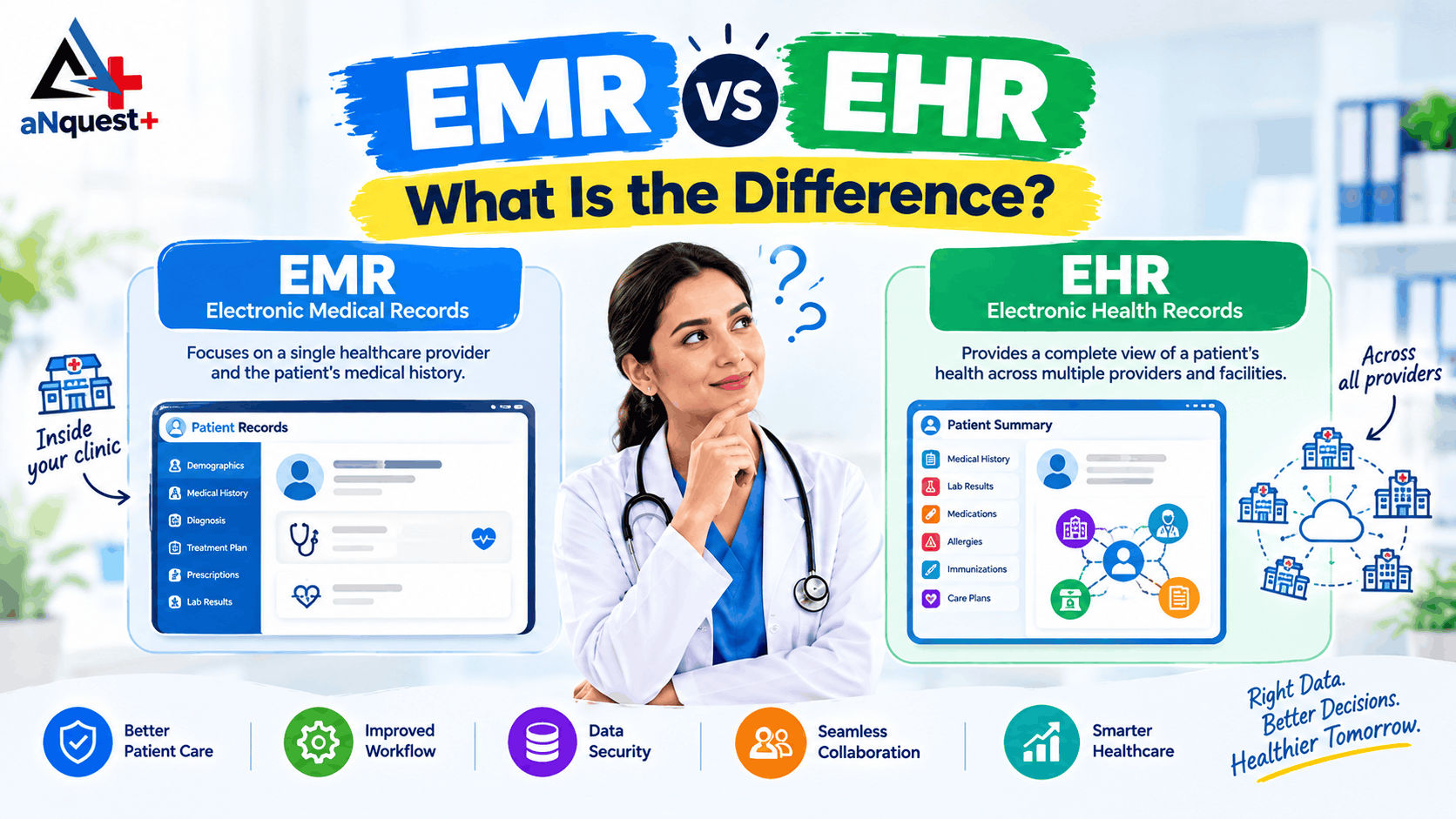
An EMR (electronic medical record) is a clinic's digital patient chart, kept and used inside one practice. An EHR (electronic health record) is a wider record designed to be shared across doctors, labs and hospitals, so it follows the patient. In short, an EMR records care at one place; an EHR connects care across places.
That's the textbook line, and it matches how the US health IT office, ONC, frames it. ONC says it uses the term EHR almost everywhere on purpose: an EMR holds the medical and treatment history of patients in one practice, while an EHR is built to be reached by everyone involved in a patient's care, including the patient. You can read their short explanation of the EMR and EHR difference if you want the original.
What is an EMR?
An EMR is the digital replacement for your paper file. Everything your clinic records about a patient lives in it: visit notes, diagnoses, prescriptions, test results, vaccinations, allergies. You and your staff use it. Nobody outside the practice does, unless you print or export something and hand it over.
Picture a patient who sees one doctor for diabetes and a cardiologist across town for her heart. Each doctor's EMR holds a different slice of her history. Neither doctor sees the other's. She carries printouts, or sends photos of reports on WhatsApp, which is still how records often move between clinics.
That isn't a flaw if you're a single clinic. An EMR is quick to set up and covers the daily work: visits, prescriptions, follow-ups, billing. If you're still moving off paper, our guide on how to manage patient records without hiring extra staff shows what that first step looks like.
What is an EHR?
An EHR starts from the patient, not the clinic. It's a record built to be shared with other doctors, labs, pharmacies and hospitals, and with the patient too. For sharing to work, the systems have to speak common standards (HL7 and FHIR are the usual names) so that one system can read what another one sends.
Take the same patient. In an EHR setup, the cardiologist can pull up the diabetes history, the latest test results and the current prescriptions without anyone chasing a printout. With her permission, always.
Note what an EHR is not. It isn't automatically bigger or more expensive software. It's software with a different design goal: sharing.
EMR vs EHR: side-by-side comparison
|
EMR |
EHR |
|
|---|---|---|
|
Built around |
One clinic's visits |
The patient's health history over time |
|
Who uses it |
Staff of one practice |
Doctors, labs, pharmacies and hospitals, plus the patient |
|
Sharing outside the practice |
Mostly manual (print, export, email) |
Designed for electronic exchange, with consent |
|
Patient access |
Often limited or through the clinic |
Normally includes a portal or app for the patient |
|
Standards |
Varies by vendor |
Built on shared standards such as HL7 and FHIR |
|
Typical fit |
Solo doctors, single clinics |
Hospitals, networks, any care that crosses providers |
|
Example |
Visit notes and prescriptions kept in one clinic |
A record that includes visits at several providers |
Are EMR and EHR the same thing?
Not quite, but they overlap more than the table suggests. Every EHR contains what an EMR contains. Plenty of products sold as "EMR" can export or exchange data, and plenty sold as "EHR" are really one clinic's chart with a patient app attached.
An Indian review of electronic records notes that many people treat the two terms as synonyms. Vendors know it, and use whichever label sells better. One Indian health-tech publication offers a handy shorthand: EMRs are encounter-centric, EHRs are patient-centric. It's a good rule to remember.
So judge the software by what it does. Can you export your data? Does it share records with another system? Can patients see their own?
EMR vs EHR in India: where ABHA and ABDM fit
India adds a national layer on top. The Ayushman Bharat Digital Mission (ABDM), run by the National Health Authority, has been live nationally since September 2021. Its building blocks are ABHA, a 14-digit health ID that any person can create; a registry of doctors; and a registry of health facilities. Records move on a consent basis: the patient agrees, and a linked system can fetch what it needs. Software makers connect to this through ABDM's developer sandbox.
For a clinic, this blurs the clean textbook split. A cloud EMR that supports ABHA-linked sharing already does part of what an EHR does. Patients can also use ABHA-enabled apps to link and share their records, again with consent.
Two cautions before you rely on that:
- "ABDM-ready" can mean very different things. On a brochure it might be a planned feature or a completed integration. Ask the vendor what is live today, and ask to see proof.
- Rules and incentives have changed since launch. Check current National Health Authority guidance for your type of facility before you make a decision based on a deadline.
Which one does your clinic need?
Don't buy the label. Buy the workflow. Four common setups:
- Solo doctor, one location. An EMR is enough, as long as it exports your data and can create or link ABHA. Spend your trial time on how fast a consultation feels. If the screen slows you down, you'll drift back to paper.
- Multi-doctor clinic. You still need an EMR, but one where every doctor sees the same patient record, with role-based access for staff and a proper appointment and queue view.
- Clinic with its own lab or pharmacy. Lab orders, results and stock should sit beside the patient record. This is where a full clinic management software setup starts to pay off.
- Hospital or multi-branch group. Departments, outside labs and insurers all need to exchange data. This is EHR territory. Ask for standards support (HL7 or FHIR) in writing.
Whichever setup you're in, put these questions to every vendor:
- Can I export all my patient data in a usable format if I leave?
- Can a record be shared with another provider, with the patient's consent?
- Can patients view their own records or prescriptions?
- What exactly is integrated with ABDM today, and can I see the documentation?
- Where is the data stored, who can see it, and is access logged?
If you're comparing options, see how aNquest+ EMR software handles OPD, prescriptions and patient communication, or look at pricing.
Frequently asked questions
What is the main difference between EMR and EHR?
An EMR is one practice's digital chart. An EHR is designed to be shared across providers and with the patient.
Is EHR better than EMR?
Not automatically. An EHR is better when care crosses providers. For a solo clinic, a good EMR may be all you need. Compare features, not names.
Is EMR or EHR used in India?
Both terms are used, often loosely. Many clinics run cloud EMRs, and ABDM adds a sharing layer through ABHA and consent-based record exchange.
Can an EMR become an EHR?
Sometimes. It can if the vendor adds standards-based exchange and patient access. If not, you'd have to migrate. Ask about the product's actual capabilities rather than assuming an upgrade path.
Do patients have access to their EMR or EHR?
EHRs typically give patients access through a portal or app. With an EMR it depends on the product. In India, patients can also use ABHA-enabled apps to link records shared with their consent.
Want to see how this works in a real clinic setup? Visit aNquest+ and ask for a walkthrough.